The Ultimate Guide to Garden Carts: Finding the Perfect Workhorse for Your Outdoor Space
When tackling landscaping projects or maintaining your garden, having the right equipment makes all the difference. Among the most essential tools for any serious gardener is a reliable garden cart. Unlike their simpler wheelbarrow cousins, garden carts offer superior stability, larger carrying capacity, and versatility that can transform how you work outdoors. In this comprehensive guide, we’ll explore the best garden carts across various categories to help you find the perfect match for your specific needs.
Why Invest in a Quality Garden Cart?
Before diving into specific recommendations, it’s worth understanding why a garden cart deserves a place in your tool shed. A high-quality garden cart can:
- Reduce physical strain on your back and joints while moving heavy materials
- Increase efficiency by allowing you to transport more in fewer trips
- Provide stability on uneven terrain where wheelbarrows might tip
- Offer versatility for hauling everything from mulch and compost to plants and tools
- Last for years (even decades) with proper maintenance
The right garden cart becomes an extension of your gardening workflow, making previously daunting tasks manageable and even enjoyable.
Key Factors to Consider When Choosing a Garden Cart
Capacity and Weight Rating
Based on my research, I’ll create a comprehensive article about garden carts that follows your editorial guidelines.
The Ultimate Guide to Garden Carts: Finding the Perfect Workhorse for Your Outdoor Space
When tackling landscaping projects or maintaining your garden, having the right equipment makes all the difference. Among the most essential tools for any serious gardener is a reliable garden cart. Unlike their simpler wheelbarrow cousins, garden carts offer superior stability, larger carrying capacity, and versatility that can transform how you work outdoors. In this comprehensive guide, we’ll explore the best garden carts across various categories to help you find the perfect match for your specific needs.
Why Invest in a Quality Garden Cart?
Before diving into specific recommendations, it’s worth understanding why a garden cart deserves a place in your tool shed. A high-quality garden cart can:
- Reduce physical strain on your back and joints while moving heavy materials
- Increase efficiency by allowing you to transport more in fewer trips
- Provide stability on uneven terrain where wheelbarrows might tip
- Offer versatility for hauling everything from mulch and compost to plants and tools
- Last for years (even decades) with proper maintenance
The right garden cart becomes an extension of your gardening workflow, making previously daunting tasks manageable and even enjoyable.
Key Factors to Consider When Choosing a Garden Cart
Capacity and Weight Rating
One of the most important considerations when selecting a garden cart is how much weight it can safely handle. Garden carts come in various capacity ratings, typically ranging from 200 pounds for light-duty models to 1,200+ pounds for heavy-duty options. Light-duty garden carts (with capacities of 200 pounds or less) are suitable for hauling limited quantities of soil, mulch, plants, and garden tools, while heavy-duty carts with capacities of 350 to 500 pounds are better for hauling rocks, bricks, and bags of concrete.
When evaluating capacity needs, consider:
- The typical materials you’ll be moving (mulch is lighter than rocks)
- The distance you’ll need to transport materials
- Your own physical capabilities (a cart rated for 800 pounds doesn’t help if you can’t move it)
- The terrain of your property (hills require more effort)
For most hobby gardeners, a lower weight capacity (200-300 pounds) should be more than sufficient for typical gardening tasks. However, if you frequently work with heavy landscaping materials or tackle large-scale projects, investing in a cart with a higher capacity rating will save you time and effort in the long run.
Bed Material and Construction
Garden carts typically feature beds made from either polyethylene plastic or steel. Each material has distinct advantages:
Polyethylene Plastic Beds:
- Lightweight and easy to maneuver
- Won’t rust or corrode when left outdoors
- Generally easier to clean (soil and mulch won’t stick)
- Resistant to denting and scratching
- Often less expensive
Steel Beds:
- Superior durability for heavy materials
- Better for transporting sharp objects that might puncture plastic
- Generally have higher weight capacities
- More resistant to UV damage
- Typically feature a mesh design that allows drainage
While plastic may not be as durable over the long term as sun exposure and extreme temperatures can degrade it, you also don’t need to worry about it rusting. Steel is usually more durable and can take more of a beating but can rust when left out in the rain.
For maximum longevity, look for powder-coated steel frames with rust-resistant finishes and high-density polyethylene beds that won’t crack or warp in extreme temperatures.
Wheel Design and Quality
Wheels are perhaps the most critical component of a garden cart, as they determine how easily it will move across your property. Several factors affect wheel performance:
Number of Wheels:
- Two-wheeled carts offer greater maneuverability in tight spaces but less stability
- Four-wheeled designs provide maximum stability for heavy loads
- Some hybrid designs offer three wheels with a unique steering mechanism
Wheel Size:
- Larger wheels (10 inches or more) navigate rough terrain and obstacles more easily
- Smaller wheels may be adequate for smooth, flat surfaces but struggle in mud or over roots
Wheel Material:
- Pneumatic (air-filled) tires provide the best shock absorption and traction but can go flat
- Solid rubber tires never go flat but offer less cushioning
- Plastic wheels are lightweight but perform poorly on uneven ground
The larger rubber tires are a little better at navigating bumpy and muddy terrain than all-plastic wheels, though both handle well for basic gardening needs.
For most garden applications, 10-inch pneumatic tires represent the sweet spot between maneuverability, cushioning, and durability.
Maneuverability and Handle Design
How you’ll steer and move your cart significantly impacts its usability. Garden carts typically feature one of three handle designs:
Pull Handles:
- Allow for pulling the cart behind you
- Reduce strain when going uphill
- Often feature a padded grip for comfort
Push Handles:
- Function more like a wheelbarrow
- Provide greater control in tight spaces
- May strain your back more than pull handles
Convertible Handles:
- Can be used for both pushing and pulling
- Offer maximum versatility
- Sometimes include a hitch option for towing behind a riding mower
Many garden cart users find that pulling a cart is easier than pushing a wheelbarrow, especially when going up a steep hill, and the stability of four wheels makes it easier to move heavy objects over extremely uneven ground.
Look for handles with ergonomic designs and comfortable grips to reduce fatigue during extended use.
Highest Rated Garden Carts for 2025
Best Overall Garden Cart: Gorilla Carts GOR4PS Poly Garden Dump Cart
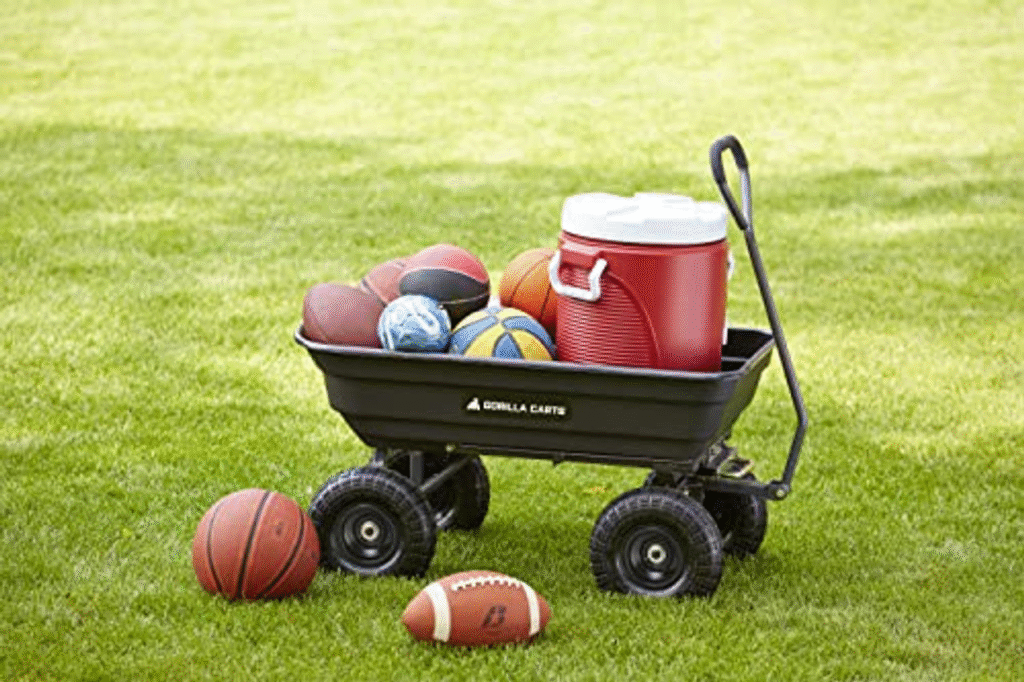
The Gorilla Carts GOR4PS combines the high weight capacity and stability of a four-wheeled garden cart with a wheelbarrow-like “quick-dumping” bed to create a best-of-both-worlds solution. With a weight capacity of 600 pounds and a poly bed that holds 4 cubic feet of material, this cart strikes an ideal balance between capacity and maneuverability.
Key Features:
- Patented quick-release dump feature for easy unloading
- 10-inch pneumatic tires that handle various terrains
- Rust-resistant poly bed with no-maintenance design
- Padded pull handle for comfortable grip
- Convertible 2-in-1 handle for towing option
- Tool-free assembly
What makes this cart stand out is its innovative dumping mechanism. Unlike other garden carts that force you to remove a pin to dump the bed, Gorilla’s cart has a quick-release handle that allows you to release the bed with a quick pull, speeding up the dumping process. This feature proves invaluable when unloading heavy materials like mulch, soil, or gravel.
Users consistently praise the Gorilla cart’s durability and ease of use, noting that the bed’s poly construction resists damage and makes cleaning simple – just hose it off when you’re done. The 10-inch pneumatic tires roll smoothly over most terrain, though they may require occasional inflation.
Best Heavy-Duty Yard Cart: Gorilla Carts Heavy-Duty Steel Utility Cart
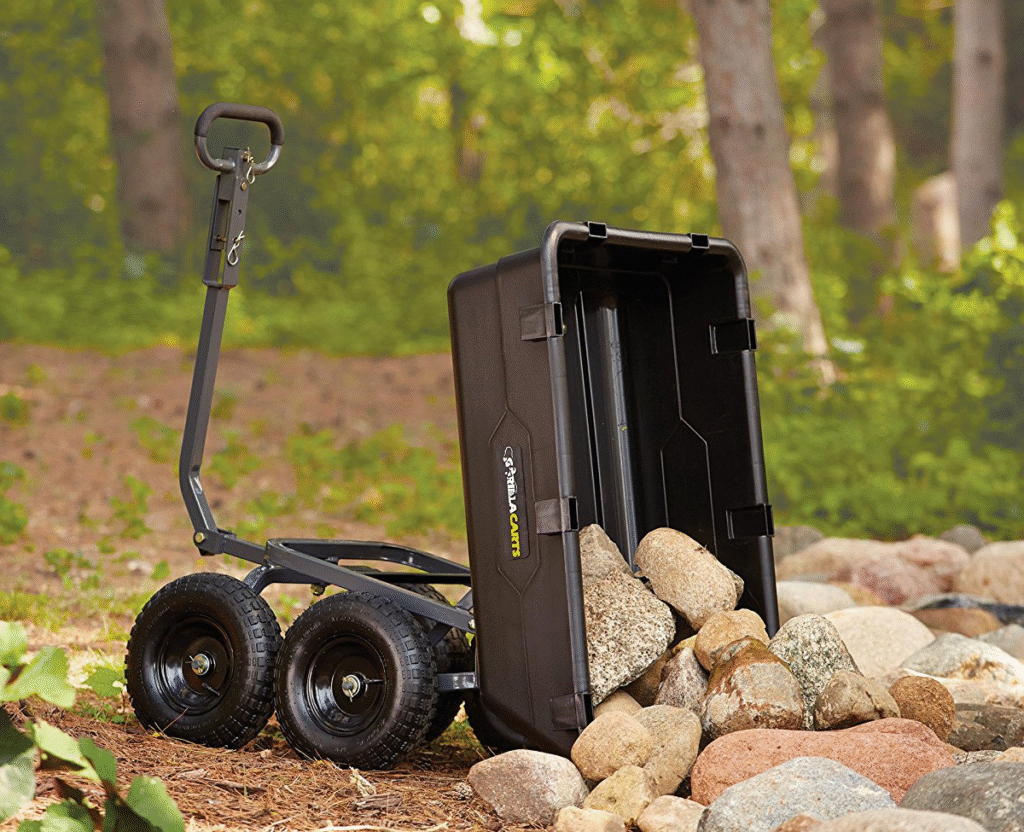
For those who regularly transport heavier loads, the Gorilla Carts Steel Utility Cart with an 800-pound capacity represents a significant step up in durability and strength. With a heavy-duty steel mesh bed and removable sides, this cart can handle everything from landscaping materials to equipment and boxes.
Key Features:
- Removable sides for flatbed functionality
- 800-pound weight capacity
- 10-inch pneumatic tires
- Steel mesh construction for durability
- Rust-resistant powder coating
- Wide, stable wheel base
The removable sides transform this cart into a flatbed for oversized loads, making it incredibly versatile for various outdoor projects. The steel mesh design allows for excellent drainage and makes the cart easy to hose down after use with mud or wet materials.
While heavier than poly models, the cart’s thoughtful design distributes weight effectively, making it manageable to pull even when loaded. The wide wheelbase provides exceptional stability but may limit maneuverability in very tight garden spaces.
Best Garden Cart Wheelbarrow Hybrid: Best Choice Products Dual-Wheel Wheelbarrow
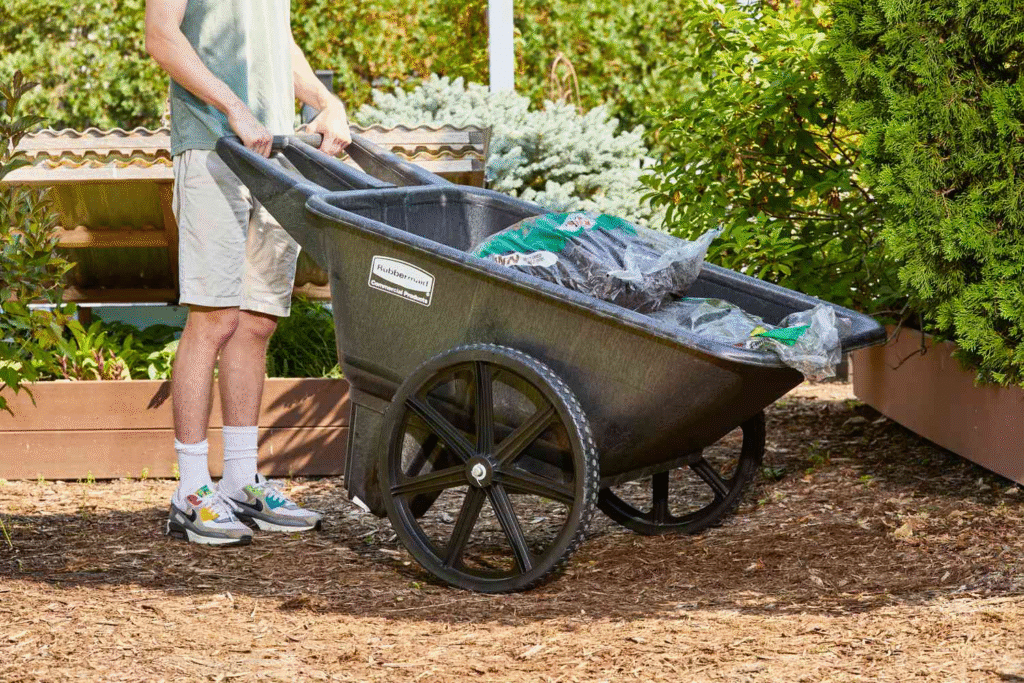
For gardeners who appreciate the familiar design of a wheelbarrow but want added stability, the Best Choice Products Dual-Wheel Wheelbarrow offers an excellent compromise. This multipurpose garden cart holds up to 5 cubic feet of soil, bricks, mulch, gravel, and more in a deep wheelbarrow-style bin with a 2-wheel design for added stability.
Key Features:
- 400-pound weight capacity
- 5 cubic feet volume capacity
- Dual 14-inch pneumatic tires for stability
- Padded handle for comfortable grip
- Plastic bin with powder-coated steel frame
- Compact storage design
The two-wheel design significantly reduces the risk of tipping compared to traditional wheelbarrows, while the deeper bin allows for hauling loose materials like mulch and soil without spillage. The traditional wheelbarrow-shaped bed is ideal for mixing up a batch of concrete or home-recipe potting soil.
Users particularly appreciate the padded handlebar, which doubles as a stand when the cart is at rest. This feature makes loading and unloading easier as the cart remains level without requiring additional support.
Best Collapsible Garden Cart: VIVOSUN Heavy-Duty Collapsible Garden Cart
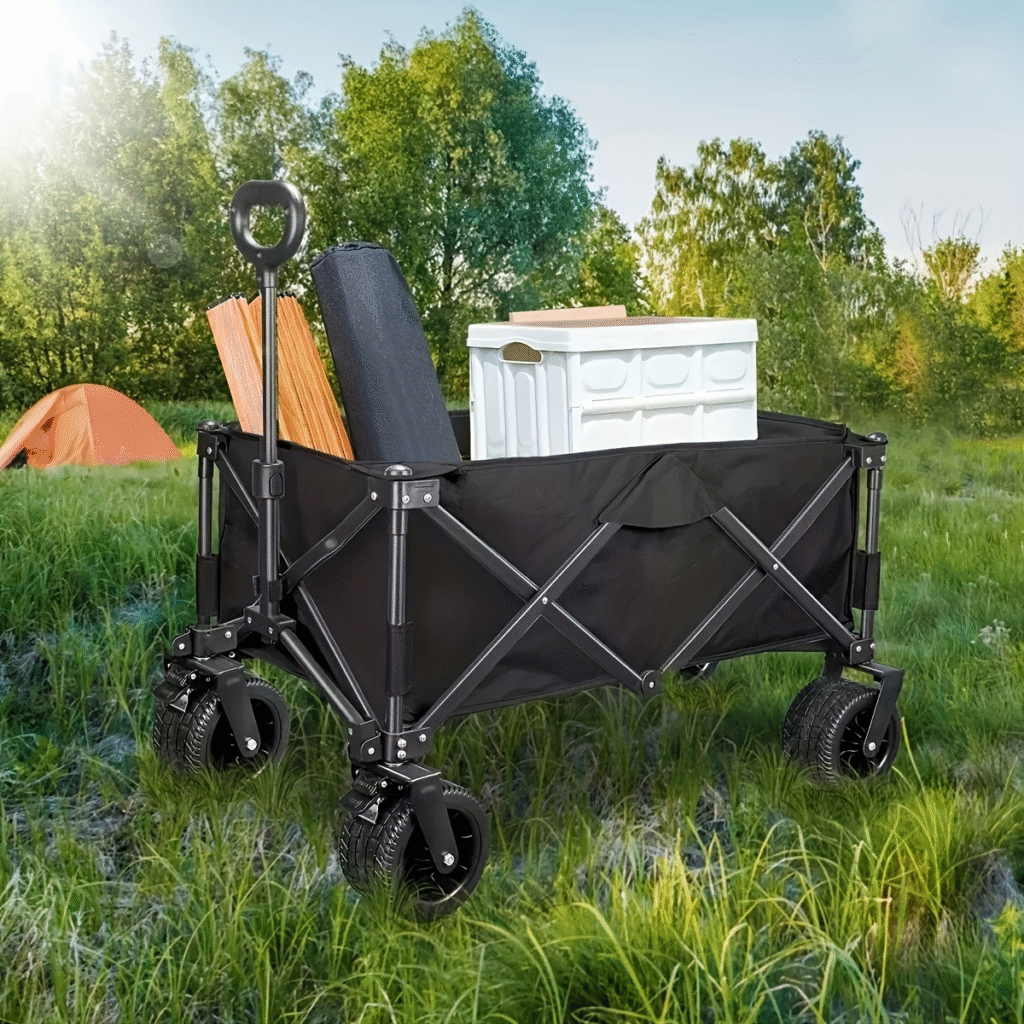
For gardeners with limited storage space, the VIVOSUN Heavy-Duty Collapsible Garden Cart provides a practical solution without sacrificing functionality. This folding wagon can lift up to 178 pounds and is constructed with a metal frame and crossed bars for additional support, featuring durable 600D oxford fabric that’s waterproof and tear-resistant.
Key Features:
- Folds flat for compact storage
- Lightweight design (under 20 pounds empty)
- Available in multiple colors
- Fabric sides contain loose materials
- Quick assembly with no tools required
- All-terrain wheels
The collapsible design makes this cart perfect for gardeners with limited storage space or those who need to transport their cart in a vehicle. Despite its lightweight construction, the cart proves surprisingly durable for moderate tasks like transporting plants, tools, and smaller bags of soil or mulch.
While not suited for heavy rocks or large quantities of dense materials, the VIVOSUN cart excels at general gardening tasks and can even double as a utility cart for camping trips or sporting events.
Best Electric Garden Cart: SuperHandy Electric Utility Wagon

For those with physical limitations or extensive properties, an electric garden cart can be a game-changer. The SuperHandy Electric Garden Cart can haul up to 1,000 pounds and hold up to 500 pounds in its bed, featuring a brushless motor system powered by rechargeable lithium-ion batteries that last anywhere from two to five hours on a single charge.
Key Features:
- Electric-powered hauling up to 1,000 pounds
- 500-pound bed capacity
- Removable side panels for flatbed conversion
- Forward and reverse capabilities
- Quiet, zero-emission operation
- Convenient dump function
The SuperHandy’s electric motor eliminates the physical strain of pulling heavy loads, making it ideal for users with back problems or larger properties. The cart features intuitive controls located at the base of the handles, allowing you to easily adjust speed and direction.
While considerably more expensive than manual options, this cart’s utility for those with physical limitations or extensive landscaping needs makes it a worthwhile investment. The extra-large pneumatic tires provide excellent traction on various terrains, though users note they may require frequent inflation.
Garden Carts vs. Wheelbarrows: Key Differences
While garden carts and wheelbarrows serve similar purposes, understanding their differences helps ensure you select the right tool for your specific needs.
Design and Stability
Wheelbarrows may have only one or two wheels and sloped or curved trays, while garden carts typically have four wheels with a large, flat bottom and straight sides. This fundamental difference affects stability, with garden carts providing a more balanced platform that’s less likely to tip.
Many users find that a garden cart with four wheels is much easier for moving large plants around the garden, given the better stability compared to a wheelbarrow where the weight can shift and cause the load to spill.
Load Capacity
Garden carts generally offer higher weight capacities than wheelbarrows. While a typical wheelbarrow might handle 300-400 pounds, many garden carts can transport 600-1,200 pounds with less effort. This higher capacity means fewer trips and less physical strain.
Maneuverability
Wheelbarrows excel in tight spaces and precise placement of materials. Their single-wheel design allows for pivoting in confined areas, which can be advantageous in narrow garden paths or densely planted areas.
Garden carts, with their four-wheel design, require more turning space but offer greater stability and typically roll more easily over rough terrain.
User Effort
A cart may be better if you’re moving heavier or bulkier items across a smooth surface as it doesn’t require as much physical effort. The pulling motion used with most garden carts typically creates less strain on the back and arms compared to the lifting and pushing required with a wheelbarrow.
Ideal Applications
Garden Carts Excel At:
- Transporting heavy loads over distance
- Moving multiple tools and supplies around the garden
- Hauling awkwardly shaped items
- Providing stability on uneven ground
- Reducing physical strain during extended use
Wheelbarrows Excel At:
- Precise placement of materials
- Navigating narrow paths and tight turns
- Mixing concrete or other materials
- Quick dumping of loads
- Compact storage
Many serious gardeners eventually own both tools, recognizing their complementary strengths for different tasks.
Practical Tips for Using Your Garden Cart
Loading Techniques
How you load your garden cart significantly impacts its stability and maneuverability:
- Balance the weight: Distribute heavy items evenly across the bed to prevent tipping.
- Load heaviest items first: Place the heaviest materials at the bottom and center of the cart.
- Don’t exceed capacity: Respect the manufacturer’s weight limits to avoid damage.
- Consider wheel position: For four-wheeled carts, keep the heaviest items nearest the axle.
- Use both hands: Always use both hands on the handle for maximum control.
Maintenance Essentials
Proper maintenance extends the life of your garden cart and ensures it performs reliably:
- Tire care: Check pneumatic tires regularly for proper inflation and wear.
- Clean after use: Rinse out the bed after transporting soil, fertilizer, or chemicals.
- Storage practices: Store indoors or under cover when possible to prevent weather damage.
- Lubricate moving parts: Apply lubricant to axles and dump mechanisms seasonally.
- Tighten hardware: Periodically check and tighten bolts and fasteners that may loosen with use.
Terrain Navigation
Different terrains require different approaches for efficient cart use:
- Uphill movement: Pull the cart behind you when going uphill for better leverage.
- Downhill control: Position yourself downhill from the cart to maintain control.
- Muddy areas: Move slowly and maintain momentum through soft spots.
- Rocky terrain: Choose a path where the wheels, not the cart bottom, will contact obstacles.
- Tight turns: Make wide, gradual turns when possible to prevent tipping.
Specialized Garden Cart Accessories
Enhance your garden cart’s functionality with these useful accessories:
Tool Holders
Attachable tool holders keep gardening implements organized and readily accessible. Look for designs that clamp to the cart’s sides without reducing interior capacity.
Seat Attachments
For gardeners who need occasional rest breaks, fold-down seat attachments transform your cart into a mobile resting spot. Some models even include built-in seats with storage underneath.
Weather Covers
Protective covers extend your cart’s lifespan by shielding it from UV rays, rain, and temperature extremes. Look for waterproof materials with secure fastening methods.
Bin Liners
Removable, washable liners make cleanup easier when transporting messy materials like compost or mulch. They also provide an additional layer of protection against wear.
Tire Upgrades
Aftermarket pneumatic tires with improved tread patterns can enhance performance on challenging terrain. Some manufacturers offer never-flat options for maintenance-free operation.
Making the Most of Your Garden Cart: Creative Uses
Beyond basic hauling tasks, your garden cart can serve multiple functions in your outdoor space:
Mobile Potting Station
With a piece of plywood secured across the top, your garden cart becomes a portable potting bench. Store soil, pots, and tools in the cart, and move the entire setup to wherever you’re working.
Harvest Helper
During harvest season, a garden cart efficiently transports produce from garden to kitchen. The elevated design reduces bending and stooping compared to traditional harvest baskets.
Composting Assistant
Use your cart to collect yard waste and kitchen scraps for your compost pile. The volume capacity makes it ideal for transporting large amounts of leaves and grass clippings.
Plant Hardening Station
When transitioning seedlings from indoors to garden, use your cart as a mobile hardening-off station. Roll plants out during the day and back to shelter at night.
Garden Tour Wagon
For garden parties or educational events, transform your cart into a mobile display of potted plants or gardening information. The mobility allows you to create different focal points throughout your landscape.
Environmental Considerations
When selecting a garden cart, consider these environmental factors:
Materials Sustainability
Look for carts made from recycled materials or those that can be recycled at the end of their useful life. Some manufacturers now offer partially recycled plastic components.
Longevity Focus
Choose high-quality carts designed for years of service rather than disposable options. Investing in durability reduces resource consumption over time.
Local Manufacturing
When possible, select garden carts produced closer to your location to reduce transportation emissions. Many quality garden cart manufacturers operate in the United States and Canada.
Repair-Friendly Design
Prioritize models with replaceable parts, making repairs possible instead of complete replacement. Manufacturers that sell replacement components support more sustainable consumption.
Conclusion: Investing in the Right Garden Cart
A quality garden cart represents one of the most significant productivity investments a gardener can make. By carefully considering your specific needs—from typical load weights and garden terrain to storage constraints and physical capabilities—you can select a cart that will serve you reliably for years.
The models highlighted in this guide represent the best options available in 2025, with the Gorilla Carts GOR4PS standing out as the best overall choice for most gardeners due to its excellent balance of capacity, durability, and user-friendly features. For those with specialized needs, alternatives like the collapsible VIVOSUN cart or the electric SuperHandy model offer tailored solutions.
Remember that the right garden cart doesn’t just make work easier—it expands what’s possible in your outdoor space by reducing physical limitations and increasing efficiency. By treating your garden cart as an essential investment rather than an optional accessory, you’ll transform your gardening experience and accomplish more with less effort.
Whether you’re a casual weekend gardener or a serious landscaper, the perfect garden cart awaits—ready to become your most valued outdoor companion for seasons to come.