The Tree Water Management Calculator helps users estimate the amount of water their tree requires based on its type, spread diameter, and daily water usage.
Steps to Use Tree Water Management/Requirement Calculator:
- Select Tree Type: Choose from the dropdown list to get the water requirement factor.
- Enter Tree Spread Diameter: Input the tree’s spread diameter in feet.
- Enter Daily Water Use: Provide the daily water consumption rate in inches.
- Click ‘Calculate Water Needs’: The calculator will compute the total water requirement for different watering periods.
- View Results: Water quantities required for 1-4 days, 5-7 days, 8-10 days, and 10+ days will be displayed.
This tool assists gardeners, landscapers, and farmers in optimizing water usage for tree health.
Formula for Water Calculation for Tree
$$Water Quantity=π×(Diameter2)2×Daily Water Use×Tree Factor$$
Example:
- Tree Type Factor: 0.75 (Peach Tree)
- Spread Diameter: 10 feet
- Daily Water Use: 0.20 inches
=$$3.1416×(10/2)2×0.20×0.75=11.78 gallons/day$$
For a 7-day watering period:
$$11.78×7=82.46 gallons$$
Water Needs of Established Landscape Trees
Established landscape trees and woody plants possess effective drought resistance mechanisms, requiring only moderate water to thrive. However, a common misconception is that they need excessive watering to perform well, leading to over-irrigation. This misunderstanding arises because, in warm and sunny conditions with abundant soil moisture, these plants may use more water than necessary.
Accurate estimation of water needs for landscape trees can be achieved through scientifically validated methods, as outlined below.
Scientific Basis for Tree Water Demand
Research indicates that using a Plant Factor (PF) of 0.5 (50%) to adjust reference evapotranspiration (ETo), calculated as ETo × 0.5, provides a reliable estimate of the water required for acceptable tree performance in most of California. This factor applies to all established, climatically adapted trees, including traditional, drought-tolerant, low-water-use, native, and “California Friendly” trees.
Methods for Estimating Water Requirements
The most accurate and simplified approaches for estimating tree water requirements include:
- SLIDE (Simplified Landscape Irrigation Demand Estimation)
- ANSI/ASABE S623 Standard
Both approaches utilize the single 0.5 PF value. To further simplify calculations, easy-to-use calculators have been developed to estimate daily and weekly water requirements for trees in common landscape scenarios. However, these calculators do not determine the precise timing or intervals for watering.
Simplified Estimation of Water Requirement
Using a uniform PF value of 0.5 simplifies the estimation process but may seem imprecise compared to plant-specific values provided in various plant lists and databases, such as the Water Use Classification of Landscape Species (WUCOLS). However, these databases lack scientific validation, and fine-tuning PF values adds minimal accuracy.
Factors such as climate, seasonal variations, soil moisture, and root system health influence tree water demand more significantly than species-specific PF values.
Factors Affecting Tree Drought Tolerance
Tree water demand is primarily met by soil moisture, which can be replenished through precipitation, irrigation, or both. In California, irrigation is typically required during the summer months to compensate for water deficits. The drought resistance of landscape trees allows flexibility in irrigation scheduling.
While most trees can perform well with 50% of ETo, certain species can endure lower amounts for extended periods. Signs of water stress in trees include:
- Wilting
- Canopy thinning
- Leaf browning at the edges
- Foliage drop
Key factors influencing drought response include:
- Extent of water reduction
- Seasonal temperature variations
- Soil moisture levels and holding capacity
- Depth and health of the root system
- Species’ natural drought resistance
A reduction of 10%-25% in irrigation during summer months may have little effect on tree health. However, trees located in turf areas without irrigation can become water-stressed within weeks.
Water Management for Trees in Turf and Unirrigated Areas
Trees in Unirrigated Turf
When turf irrigation is eliminated, trees initially compete with grass for soil moisture. Turfgrass typically turns brown and dormant within 2-4 weeks of irrigation cessation. Trees may experience moderate to severe stress shortly after.
To manage water effectively:
- Kill dormant turf to reduce competition.
- Apply mulch to retain soil moisture.
- Retrofit irrigation systems to drip irrigation for efficient watering.
Trees in Healthy Turfgrass
Trees located in turf-covered areas such as medians and lawns receive water indirectly through turf irrigation. The following formula estimates water requirements:
Equation 1: Gallons = ETo × PF × LA × 0.623
OR
Inches = ETo × PF
Where:
- ETo: Evapotranspiration (inches)
- PF: Plant Factor (0.8 for cool-season grass, 0.6 for warm-season grass)
- LA: Planted area (sq. ft.)
- 0.623: Conversion factor from inches to gallons
Isolated Trees
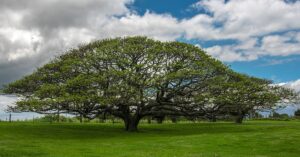
For trees with widely spaced canopies, estimating water needs requires calculating the transpiring leaf area using the tree’s canopy diameter:
Equation 2: Gallons = ETo × PF × (π × R²) × 0.623
OR
Inches = ETo × PF × (π × R²)
Where:
- R: Radius (canopy diameter ÷ 2)
- π (Pi): 3.14
- PF: 0.5 (for all trees)
- 0.623: Conversion factor
Closely Spaced Trees and Mixed Plantings
For trees covering 80% or more of the landscape, water requirements can be estimated using the planted area and appropriate PF values:
Equation 3: Gallons = ETo × PF × LA × 0.623
OR
Inches = ETo × PF
For mixed plantings, the highest PF among plant types should be used (e.g., 0.5 for trees, shrubs, vines; 0.8 for annuals).
Conclusion
Proper water management ensures healthy tree growth while conserving resources. Utilizing scientifically backed methods like SLIDE and ANSI/ASABE S623 Standards simplifies estimation and improves water efficiency across various landscape settings.
FAQs on Tree Water Management Calculator
- What is the purpose of this calculator?
It helps determine the optimal water requirement for different tree types. - How is the tree type factor determined?
It is based on research data for each species’ water needs. - What units are used for calculations?
Diameter is in feet, and water use is in inches. - Can I use this for shrubs?
Yes, as long as you input the correct spread diameter. - Does it consider rainfall?
No, it only calculates based on input values. - What if I enter incorrect values?
The calculator will prompt “Invalid input.” - How often should I water my tree?
The output provides estimates for different watering periods. - Is the calculation accurate for all regions?
Adjustments may be needed based on local climate. - Can I calculate water for multiple trees?
Yes, enter values for each tree separately. - Is the water calculation suitable for commercial farming?
Yes, it can be used for large-scale agricultural planning.